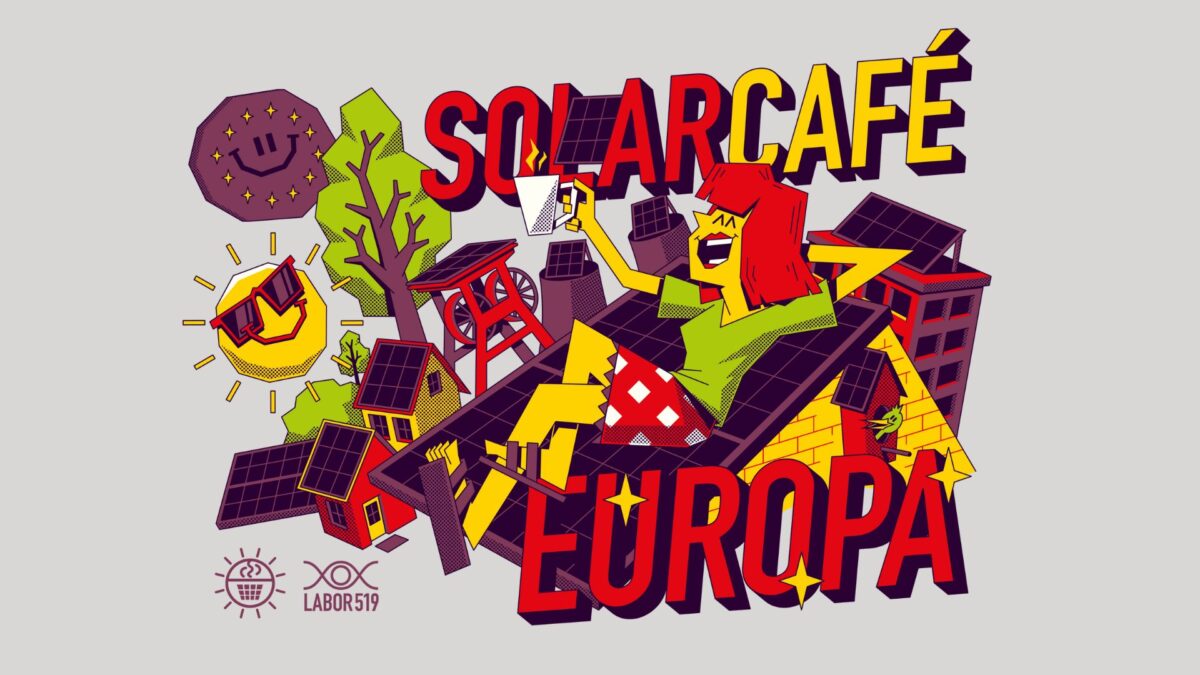
 Solar Café Europe – What Our Neighbours Do
Industrial Heritage Meets Energy Transition
Essen / Ruhr Region, Germany
Discover how former industrial regions across Europe are transforming towards a citizen-driven energy future — and what the Ruhr region can learn from them.
Our three-session programme brings together experts, practitioners, community initiatives, and engaged citizens for exchange, inspiration, and hands-on learning.
Why international professionals should join
✔ Learn from Europe’s industrial regions
See how partner regions (e.g., Sussex, Piedmont, …) convert industrial heritage and brownfields into drivers for community-led renewable energy.
✔ Compare approaches & methodologies
Understand how different governance models, funding structures, and citizen-participation formats shape successful community-energy projects.
✔ Build partnerships in the Ruhr region
Network with municipal actors, researchers, energy cooperatives, and local practitioners who are opening their processes to international collaboration.
✔ Experience applied energy transition
Workshops, demonstrations, and hands-on tinkering provide a practical understanding of small-scale PV, community ownership models, and feasibility tools.
Dates / Impacts
Sun, 7 Dec 2025 – Kick-off 1
10:00–12:00 CET
Solar Café Europa - Status quo
Industrial Heritage Meets Energy Transition – The discussion focused on the Ruhr region’s industrial legacy and how this unique context could foster strong community trust in community energy.
The Kickoff:
The main question: How can we replace yet another gas power plant?
A collection of data and facts was prepared with support from the Regional Association Ruhr (RVR). The session aimed to assess how local energy cooperatives operate and what challenges they face.
Keynotes
Hannah Müller (FernUniversität Hagen) defined the international understanding of community energy: bottom-up, scalable concepts that rely solely on internal investment/reinvestment, remain self-managed in a cooperative sense, and are independent of land ownership or subsidies from major energy providers. She highlighted aspects such as participant recruitment, public outreach, and fundraising — all viewed as social entrepreneurship. Müller showed how community energy can become a socially sustainable investment and called for lower entry barriers for cooperatives.
Norbert Ross (Klimaagentur Rhein-Ruhr) reported from his consulting work about major information gaps among the general public and explained current funding opportunities.
Thomas Tschiesche (Bürgerenergiegenossenschaft Ruhr West) – association primarily active in Mülheim an der Ruhr – presented a straightforward business report and introduced a planned 5-hectare solar project. He shared lessons from recent years: addressing the information gap requires staffing costs, yet small-scale systems generate too little profit to cover them. The feasibility of projects depends heavily on the willingness of municipal administrations to cooperate.
Josef Quanz (BEG 58 Hagen) described the great success story of photovoltaics worldwide. The BEG builds and operates PV systems in cooperation with its roof partners — housing companies, municipalities, and social organizations. Special in the region is the “Mitmach-PV” (participatory PV) group, which builds and maintains the systems. Around 80 cooperative members are actively involved. In this way, many projects in the southeastern Ruhr area have been realized. Members receive an annual return of about 3.5%, and social projects are also supported through the profits.
The situation of the cooperatives varies greatly; their success often depends on the attitude of city administrations and the ability of members to contribute personally.
The big surprise: All cooperatives report rising membership numbers — at a time when civic participation is generally declining.
However, there is still no broad movement.
Where does the lack of trust come from? What reservations or fears exist regarding technology, administration, or regulations?
How do our European neighbors handle this?
A mix of smart investment, extensive public engagement, and diverse partnerships proves successful.
In group work, participatory concepts were developed to better reflect the international idea of community energy — which encompasses not only construction but also counseling, advocacy, and voluntary engagement:
Examples included pub tours, community center initiatives, and everyday objects — not just solar panels but also fabrics, roof tiles, and films that can be PV-capable, offering a wide range of applications.
Technical topics such as grid expansion, smart meters, and storage options were compared internationally, leading to two key findings:
-
The Ruhr region has enough unused space to replace a medium-sized gas power plant.
-
Cooperation over competition — always.
Sun, 7 Dec 2025 – Kick-off 2
10:00–12:00 CET
Solar Café Europa #2 – Our Neighbors and Us
How do other regions manage to pool capacities, unlock potential, and build trust among large groups of people who often have never even heard of community energy? Which challenges must be addressed — and how do these appear from an outside perspective?
10:00–12:00
-
Richard Watson and Kate Meakin (Energize Sussex Coast, UK) – via video presentation on successful community energy projects in southern England; they will also join the following discussion.
-
Silke Johanndeiter and students from the Chair of Energy Systems & Economics, Ruhr University Bochum – on current legal frameworks.
-
Solarenergie-Förderverein Aachen – on solutions for tenant electricity models.
-
Ansgar Alm, Green Capital Agency Essen – on municipal funding programs and advisory services.
For both audience and speakers, a small stage will host the quiz show “Project Development Poker”, along with snacks and baked beans on toast.
The follow-up session will turn the discussion round into a hands-on crafting activity:
Sun, 7 Dec 2025 – Family Workshop
13:00–15:00 CET
Solar Lamp Building
Hands-on workshop for families to understand PV basics, storage, and DIY solar tech.
Sat, 13 Dec 2025 – Impact & Learnings
10:00–12:00 CET
Ideas for our future
Synthesis of insights, transferability, and next steps for the Ruhr region.
Co-creation lab on future project ideas.
Venue
REALFOODSPACE Essen – Home of Labor 519 e. V.
Mathildenstr. 23, 45130 Essen
(Parking on request)
Team – Solar Café Europe
- Hannah Müller – Researcher “Energy Communing”, FernUniversität Hagen
- Daniela Petry – Initiator, Solar Café Europe
- Norbert Ross – Electrical Engineer, PV Consulting, Klimaagentur Rhein-Ruhr; Initiator Heisingen Klimabewusst
Participants
Invited partners from:
- Essen / Ruhr Region
- European partner regions with industrial heritage
Format
Hybrid event (on-site + online)
Workshops • Talks • Networking • Food • Music
Open to citizens, professionals, initiatives, cities, and researchers.
Objective
Exchange best practices in community energy across Europe,
co-create ideas for the Ruhr region
To understand community-energy we suggest RESCOOP Europe
Part of an ongoing feasibility study integrating citizen participation.
Questions / Registration
📧 kontakt@labor519.de
📞 +49 176 24022904
